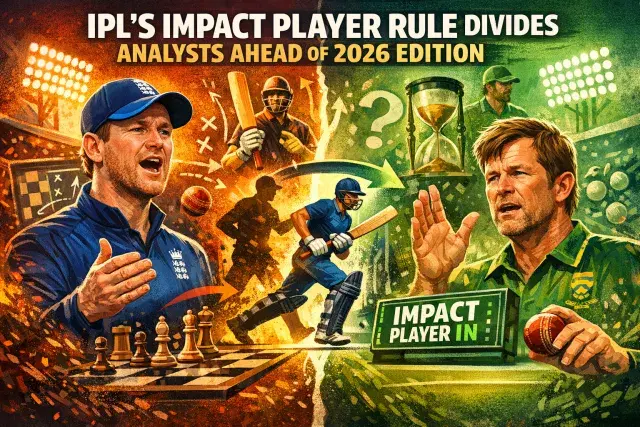
IPL's Impact Player Rule Divides Analysts Ahead of 2026 Edition

A single substitution rule has become one of the most debated structural changes in professional cricket's most commercially powerful annual event. As the 2026 Indian Premier League draws closer, the so-called Impact Player rule — introduced in 2022 — continues to polarize opinion among those who shape and study the format. Two prominent analysts associated with Parimatch, Eoin Morgan and Jonty Rhodes, have staked out sharply different positions on what the rule means for the game's integrity and its future.
What the Rule Actually Does
The Impact Player provision allows a side to introduce an additional named substitute at a designated point during a fixture, effectively expanding the active roster beyond the conventional eleven. Unlike a simple injury replacement, this substitution carries tactical intent — a side can bring in a specialist to respond to the specific demands of a situation as it unfolds.
The mechanism borrows from a logic well established in other high-contact or high-pace formats of sport, where rolling substitutions or tactical switches are commonplace. In cricket, however, the convention had long been that eleven names on a sheet defined both offensive and defensive capacity for the entire duration of play. The Impact Player rule breaks that convention deliberately, repositioning in-game decision-making as a skill in itself.
Rhodes: Versatility Loses Its Premium
Jonty Rhodes, whose analytical work has focused heavily on fielding and multi-dimensional value, argues that the rule fundamentally erodes the case for all-round ability. When a side knows it can insert a specialist at will, the calculus around selecting a player who bats competently and contributes with the ball shifts considerably. The all-rounder — historically valued precisely because one person can do the work of two — becomes less indispensable when the roster can be reconfigured mid-contest.
This concern carries implications beyond individual selection decisions. The development pipeline for multi-skilled cricketers is shaped in part by the conditions that reward them. If a format that commands enormous viewership and financial investment systematically undervalues versatility, younger cricketers and their coaches will notice. Career incentives tend to follow structural incentives, and formats shape careers over time as much as they shape results in the short term.
Morgan: Tactical Flexibility as a Feature
Eoin Morgan, who captained England to a World Cup victory in the fifty-over format and has extensive experience reading high-pressure conditions, takes a more open view. For Morgan, the rule expands rather than distorts the strategic dimension of the format. The ability to make a well-timed substitution — reading conditions, opposition momentum, or the specific demands of a final phase of batting — introduces a layer of decision-making that rewards preparation and tactical intelligence.
He draws an implicit parallel to how other sports have evolved: the capacity to adapt personnel to shifting in-game circumstances is not a corruption of competition but an enrichment of it. From a spectator perspective, the unpredictability introduced by potential substitutions adds a dimension of anticipation. Morgan acknowledges, however, that questions remain about whether habits cultivated in this format transfer productively to international cricket, where no equivalent provision exists.
The Broader Question of Format and Consequence
The debate between Rhodes and Morgan is, at its core, a debate about what elite cricket is trying to optimise for. The IPL operates at the intersection of entertainment, commerce, and sporting competition — and those three objectives do not always produce the same answers. Rules that heighten spectacle and reward bold tactical decisions may generate the short-format energy that broadcasters and audiences respond to, while simultaneously creating development conditions that diverge from the demands of Test or even fifty-over cricket.
This tension is not unique to cricket. Any format that commands disproportionate financial and media gravity will inevitably influence how the broader sport develops its talent, its culture, and its norms. Whether the Impact Player rule proves to be a durable innovation or a format-specific experiment that eventually gets revisited will depend on how the evidence accumulates — in results, in selection patterns, and in the careers of the players who come of age under its conditions. That evidence, in 2026, is still forming.